www.developer.com/java/article.php/1381491
Back to
Article
Introduction to
Java Algorithms in Control Systems
By Sione Palu
July 8, 2002
Introduction
There has been a huge support and interests from industries, government
agencies, academic institutions for the draft of the RTSJ API, that
is the Real Time Specification for Java which had a final release
at the beginning of this year, 2002. Companies who have taken interests
are the big heavyweight industries in embedded systems and real time
computer control. Since RTSJ addressed the issues of the Java
language specification which hindered its application in real time
systems, I would expect competition from different vendors in this market
over the coming years. Since developing software in real time computer
control is a little different from data processing development, in this
article I will discuss an introductory level to Control Systems
engineering with some common algorithm implemented in Java. This is a huge
field, and you are encouraged to get some published material (refer
Resources), for further self study, if your interests lie in the area of
robotics and real time computer control.
Concern of Control Systems Engineering
Control Systems Engineering are concerned with understanding
segments of their environment, often called systems to provide
useful economic products for society. Control Engineering must often
consider the control of poorly understood systems such as chemical
process systems. The current challenge to Control Systems
Engineering is the modelling and the control of modern, complex,
interrelated systems such as traffic control systems, chemical processes,
robotic systems and industrial automation systems. All the challenges aim
to solve control problems that affect the whole of society. Control
Systems Engineering is based on the foundations of feedback
theory and linear systems analysis. It is an interconnection of
components forming a system configuration that will provide a desired
system response.
Historical Background to Automatic Control Systems
Mechanical feedback control systems appeared in Greece from around 300
B.C onward in the development of the float regulator mechanisms. Float
regulator mechanisms is still in use today, as in the water tank of the
ordinary flush toilet. The first formal study of the "Theory of Control"
started in the mid 1860s with a paper published by physicist J.C.Maxwell,
the inventor of the theory of "Electro-Magnetism" . Work on the stability
of control systems appeared towards mid 1890s by mathematicians notably
E.J. Routh and A.M. Lyapunov. These two mathematicians both have their
names honoured by the control engineering community with the naming of
"Routh Stability Test" and the "Lyapunov Stability Criteria", which is
found in almost all literature on control. During the 1930s, H. Nyquist
from Bell Telephone Laboratories, applied frequency analysis to control
systems design. Around the same time Electronic amplifiers from Bell
Telephone appeared. Developed by H.W.Bode, such amplifiers were designed
using the concepts of feedback control. From the 1950s onwards, control
theory evolved with new mathematical techniques applied and computer
technology becoming a substitute for mechanical control or human task
oriented control systems.
Discipline of Control Systems
Control Systems Engineering is a multi-disciplinary field. It
covers areas as, Mechanical Engineering, Chemical Engineering, Electrical
& Electronic Engineering, Environmental, Civil, Physics, Economics and
Finance, Artificial Intelligence and Computer Science. Control Systems
Engineering is still taught in main stream Engineering and Physics
courses. Within the last decade or so it has started to appear in Computer
Science courses and as post-graduate papers in Real-Time Computer
Control.
One of the emerging fields of Control Systems Engineering is
Financial Engineering Control. This branch of engineering deals
with the dynamic modelling of finance and economic systems. The majority
of courses in Financial Engineering Control are still taught at
post-graduate level in Mathematics, Physics and Engineering. I have not
seen many academic institutions on the internet, that teach Financial
Engineering Control for MBA courses, and the ones that do have a
pre-requisite requiring the candidate(applicant) to have completed courses
in theoretical Physics, Mathematics or Engineering. Engineers in
Financial Engineering Control use the same models and concepts as
feedback and feed-forward control that are found in aircraft
control systems or chemical process systems and apply them to financial
and economic dynamic systems.
Computer Control Systems is one of the most complex fields in control
engineering. For example, designing the control systems for a chemical
process system would involve different types of engineers from the
beginning. A mechanical engineer would specify and design most of the
machinery parts and the electrical engineer will figure out how all these
complex parts are wired together, what type of sensors and actuators to
specify, and also how it all function as a whole. An actuator is a
device that provides the motive power to the process, example is a
dc motor. The chemical engineer will specify the time reaction of
certain chemicals and the optimal temperature and pressure for operations.
The software engineer will play the role of integrating all specifications
by writing the software that meets the functional requirement of the other
engineers. All these engineers, must communicate before and during the
whole project, with each and every one understanding the language of
Control Systems Engineering. Control Systems design parameters such
as process rise-time, peak-time, settling-time,
percentage-over-shoot and so on, must be well understood by all
engineers involved.
Concepts in Control Systems Engineering overlap with concepts in
the branch of Physics and Electrical Engineering known as Digital Signal
Processing (DSP) and Communication Systems, where analysis is done in
frequency domain or time domain exactly as is done in Control Systems.
There are disciplines that a DSP or a Communication Systems engineer would
also use in designing embedded Real-Time Computer Control Systems.
Revising the Mathematics of Control
Understanding of complex control systems requires quantitative
mathematical models of these systems. Systems under consideration are
dynamic in nature. The model descriptive equations are usually
differential equations. If non-linearity arises for any model
problem, then it has to be linearized before a technique called Laplace
Transform from differential equations is applied to the problem.
Linearization of model problems is done using a technique in calculus
called Taylor Series Expansions. For example, in the dairy industry
or liquid chemical processes, all fluid-flow exhibit non-linear flow (when
rate of fluid-flow per unit volume is not proportional to time anymore)
through (steel) pipes or tubes, at certain cut-off temperature or
pressure. Non-linear fluid flow found in these industries is very complex
to model where all the control parameters are needed to be simplified
during design time. Engineers linearized physical quantity as rate of
fluid-flow using Taylor Series so that they can apply Laplace
Transform and it becomes easy to manipulate algebraicly.
| Equation 1: Laplace Transform |
|
 |
An example of Laplace Transform is when the input control signal
is a sine-wave of the form: f(t)=A*sin(w*t), where "w" is
the frequency (units in hertz), "A" is the signal's amplitude
(signal's maximum height, usually measured in milli-volts, or milli-amps).
The result is shown in Equation 2.
| Equation 2: Laplace Transform of a sine-wave control
signal |
|
 |
When the response of the control systems to input signal is allowed
enough time(infinite) to settle, it is called steady-state or
final-value of the output. Estimation of steady-state is vital for
accuracy of control systems to some tolerance value (error). In aircraft
control, for example, if a sudden change of altitude is caused by a
turbulence, the computer will restore the craft to its steady-state
quite fast, because the real-time computer systems is tracking non-stop,
the craft's current input set-point control parameters such as altitude,
attitude and so on.
Transfer function of a linear system is defined as the ratio of
the Laplace Transform of the output variable to the Laplace
Transform of the input variable, with initial conditions assumed to be
zero. If you have worked with Photoshop, then you must have come across
the concept of transfer function, it is exactly the same mathematics as
discussed here. Transfer functions in Photoshop enable you to compensate
for dot gain between the image and film. For example, the Transfer
function makes 50% dots in the image print as 50% dots on film. The
concept of transfer function is widely used is Signal Processing,
Electronics, Image Processing and Control Systems.
| Equation 3: Input-Output in matrix-form (m x n) |
|
 |
Knowledge of differential calculus, complex numbers, graph theory,
matrix algebra and numerical algorithms are required for Control Systems
analysis, design and simulation. You will simulate important control
parameters using a computer and, once you are satisfied, the functional
requirement is finalized. You, the control systems software engineer, then
write the control softwares using the numerical algorithms from the
simulations.
Block Diagrams
Dynamic systems that comprise automatic control systems are represented
mathematically by a set of simultaneous differential equations. Applying
Laplace Transform to the linear differential equations reduces the
problem to a set of linear algebraic equations. Since control systems are
concerned with the control of specific variables, the interrelationship of
the controlled variables to the controlling variables is required. This
relationship is represented by the transfer function of the
subsystem relating the input and output variables.
| Figure 1 |
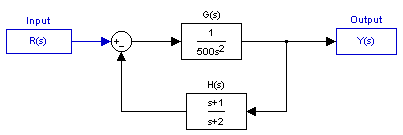 |
The block diagram of Figure 1 above represents a simple
negative-feedback (output is feeding to the input, where it is
subtracted from the input) control systems. The laplace-transformed
function G(s), represents the plant (a physical system to be
controlled), and H(s) represents that of the feed-back-gain.
Using the methods of block-diagram-transformation (breaking of
nested multiple loops into an equivalent simple open loop), the close-loop
negative-feedback control systems of figure Figure 1 is reduced to
an open-loop control system of Figure 2 below. The opposite of
negative-feedback is positive-feedback, where the output is
added to the input instead of subtracting. You would have experienced
positive-feedback in a rock concert where the performer(singer) is
coming close to one of the huge loud speakers with the microphone, which
caused a loud high pitch sound. This is because the loud speakers(output)
is added to the performer's voice as input to the microphone. Block
diagrams for positive-feedback is the same for
negative-feedback except that the summer block has two positives
(++). When the laplace-transformed function H(s) equals 1
(H(s) = 1), the negative-feedback or
positive-feedback control systems is called Unity Gain. Its
block diagram representation is exactly the same as in Figure 1, but the
block H(s) is removed, leaving just the loop line.
| Figure 2 |
 |
The overall ratio of the laplace-transform of output Y(s)
to input R(s) is the transfer function T(s) of the
negative-feedback control system of Figure 1. After substitution of
functions G(s) and H(s) from Figure 1 into Equation 4(a)
with further algebraic manipulation, T(s) is simplified to that in
Equation 4(b) shown below.
| Equation 4: Overall Transfer Function |
|
 |
The block diagram of Figure 1 represents a single-input and a
single-output (SISO). The input-output matrix form of Equation 3,
represents the general relations of control variables which has
multiple-input and multiple-output (MIMO). The MIMO type systems are what
you find in large scale control systems as shown in Figure 3 below, with
"n" inputs and "m" different outputs.
| Figure 3 |
 | |
State Variables Model
A systems state is described as a set of variables such that the
knowledge of these variables and the input functions will, with the
equations describing the dynamics, provide the future state and the output
of the system. A simple example, is the state of an "on-off" switch. The
switch can be in either the "on" or the "off" position, and thus the state
of the switch can be assumed to be one of two possible values. If you know
the present state(position) of the switch at time to and
if an input is applied, you are able to determine the future value of the
element.
System Responses and Control Parameters
System responses are categorized into three main excitation(input)
signals:
- Step Response: Signal is equal to a constant value
- Ramp Response: Signal is proportional to time (t)
- Parabolic Response: Signal is proportional to square of time
(t2)
I will only mention Step response here, because of its
generality in Control Systems engineering. An example of a step
response is Car Suspension Systems. When the car travelling on the
road encounters a bump or a hole, the car will experience a shaky
vibration (vertical), this type of excitation input (bump) is a step.
Mechanical control engineers have designed automobile suspension system
with the shock-absorber to restore the steady-state (equilibrium)
of the car in a short period of time (around one second time span). The
time it takes for the system (car) to reach equilibrium is called
settling-time, and it is an important design parameter for all
control systems, regardless of whether it is electrical, computer,
mechanical, or chemical control. Imagine an automobile where the
suspension systems has a long duration settling-time, say 10
seconds. Such an automobile would be uncomfortable to travel in.
The following diagram, Figure 4 is an arbitrary response to a Step
Input signal (of constant value of 1), with some of the important
control systems parameters clearly labelled.
| Figure 4 |
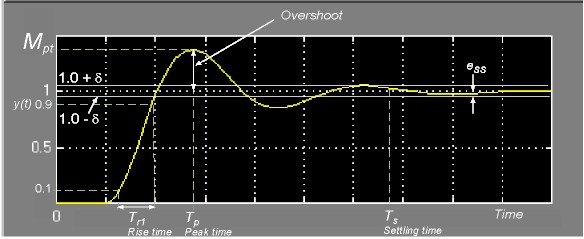 |
The following control parameters are the time-response specification
for any control systems design:
- Rise-time ( tr ): This is the amount of time, it
takes the system to reach around 90% of its new set-point.
- Settling-time ( ts ): The time it takes the system
to reach equilibrium to some tolerance level.
- Peak-time ( tp ): The time that requires the
system to reach the maximum over-shoot point.
- Over-shoot ( Mp ): This the amount that the system
over-shoots its final-value (steady-state) or equilibrium value divided
by its final-value (usually express in percentage).
There is an applet at the end of this article, that you may want to
open it right now and experiment with optimising control parameters
mentioned above by inputting transfer function of a control systems and
click plot.
Proportional Integral Derivative (P.I.D) Controllers
PID controller (Proportional Integral Derivative) is widely used
in industrial process control. Its popularity in industry can be
attributed partly to their robust performance in a wide range of operating
conditions and to its functional simplicity. There are three parameters
which must be determined for the given process if it is to implement PID
controllers in any control process.
- Proportional Gain ( KP ):
- Integral Gain ( KI ):
- Derivative Gain ( KD ):
The origin of the PID controller model obviously stems from calculus,
as the name suggested. It is exactly the same as it is used in calculus.
Its frequency-domain and time-domain representation are shown below as
Equation 5 and Equation 6 :
| Equation 5: PID Transfer Function (frequency-domain) |
|
 |
| Equation 6: PID Output (time-domain) |
|
 |
For example, suppose you have an arbitrary simple input control signal
as a sine-wave of the form: r(t) = Sin(t). If this signal passes
through the PID controller, the output after applying Equation 6 (PID
time-domain) would be: y(t) = KP.Sin(t) -
KI.Cos(t) + KD.Cos(t). You can probably see how
the Sin(t) function integrates to become -Cos(t) and also
the derivative of Sin(t) became Cos(t).
Numerical Integration Algorithm
There are a number of different numerical integration algorithms
available for numerical computing, but the Runge-Kutta of fourth
order (RK4) is commonly used in control systems design,
particularly in PID controllers. RK4 is generally used to solve
numerical answer to the type of differential equation with initial value
as expressed in Equation 7, below. Note that Equation 6 is a variant of
the general form, Equation 7:
| Equation 7: General First-Order Initial-Value Differential
Equation |
|
 |
The following Listing 1 shows the RK4 algorithm:
| Listing 1: (RK4 Algorithm) |
	Input_Parameters :
	   boundaries endpoints (double floating) a, b ;
	   integer N ;
	   initial condition (double floating) yo ;
	Return_Value :
	   approximation of z to y at the (N+1) values of t


	Step 1:
		//Assign:
		h <- (b-a)/N;
		t <- a;
		z <- yo;
		Return_Value(t,z);
	Step 2:
		For i = 1, ..., N
		  //Assign:
		  K1 <- h*f(t,z);
		  K2 <- h*f(t + h/2, z + K1/2);
		  K3 <- h*f(t + h/2, z + K2/2);
		  K4 <- h*f(t + h, z + K3);

		  z <- z + (K1 + 2*K2 + 2*K3 + K4)/6; //compute zi
		  t <- a + i*h ;  //compute ti

		  Return_Value(t,z);

		End For
	Step 3: Terminate
|
The algorithm in Listing 1, is easy to implement in Java. I have
included the algorithm because you may like to implement it slightly
differently. RK4 algorithms are found in many differential equations and
numerical analysis books (refer resources). This algorithm is also
implemented in a free source (GNU) library called JSci (Java API
for Science), and also in commercial numerical Java libraries(refer
resources). I implement it a little differently from JSci, so that
the instruction flow from the algorithm in Listing 1 is easy to follow and
also clear to you. Listing 2 is the implementation.
| Listing 2: (RK4 Implementation) |
public interface IntegrableFunction{
  public double functionMap(double T, double Z);
 }

public class RK4 implements IntegrableFunction{

  public double[][] compute(double a,double b,int N,double inVal){

    double[][] rVal = new double[2][];
    double[] timePoints = new double[N+1];
    double[] signalPoints = new double[N+1];

    rVal[0] = timePoints;
    rVal[1] = signalPoints;

    //Step 1, assignment
    double h = (b-a)/(double)N;
    double t = a;
    double z = initialVal;

    //initial points
    timePoints[0] = t;
    signalPoints[0] = z;

	//initialize
    double K1 = 1.0, K2 = 1.0, K3 = 1.0, K4 = 1.0;

	//Step 2, looping
    for(int i=1; i<=N; i++){
      //assigment
      K1 = h*functionMap(t,z);
      K2 = h*functionMap(t + h/2, z + K1/2);
      K3 = h*functionMap(t + h/2, z + K2/2);
      K4 = h*functionMap(t + h, z + K3);

      z = z + (K1 + 2*K2 + 2*K3 + K4)/6.0;
      t = a + i*h;

      timePoints[i] = t;
      signalPoints[i] = z;
     }//end for

    //terminate
    return rVal;
   }//end method

  public double functionMap(double T, double Z){
    double val = 1.0;
    val = Z - T*T +1; //Implement your own function here.
    return val;
   }//end method

 }//------------ End RK4 Class Definition ---------------
|
RK4 is one of the very useful numerical techniques. It is widely
used in scientific and engineering computations. You will find numerous
applications of RK4 outside control systems, such as financial
modelling, inventory control, signal processing.
Control System Design Process
There are seven main groups in the process of designing:
| Table 1: Main Groups in the process of designing |
- Establish Control Goals
- Determine variables to be controlled
- Write specifications
- Determine the configuration of the system
- Establish process model, sensors and actuators
- Controller's description and choose adjustable control
parameters
- Optimize control parameters and analyse performance
|
If the performance meets specification from step (g) of the list above,
then finalize the design, else start from step (d) until control
specifications are met.
Common Control Algorithm
Equations 5 and Equation 6 are both analog or continuous
representations. Since Equation 6 is continuous, modern control use
digital controllers. The analog Laplace Transform representation of
Equation 5 is converted into discrete form (digital) by using
Z-Transformation techniques of Discrete Mathematics. The
resulting deriviations and simplifications of the digital controller, are
shown below in Equation 8(a) and Equation 8(b).
| Equation 8(a): |
| s(n) = s(n-1) + e(n) |
| Equation 8(b): |
| m(n) = Kp*e(n) + Ki*s(n) +
Kd*{ e(n) - e(n-1) } |
| s(n) - error summation from time interval t=0 to t=n*T, where T
is sampling time. |
| e(n) - controller error signal |
| m(n) - controller output |
| Kp - controller proportional gain |
| Ki - controller integral gain |
| Kd - controller derivative
gain |
Implementing Equation 8 can be a simple task. The following Listing 3
shows the simple digital controller.
| Listing 4: (Basic PID) |
/*
 * This class ignores all timing problems and
 * practical problems.
 */
public class PIDController{

  //Declare an instance variable
  //of ADC object (Analog-to-Digital-Converter)
  ADC adc ;
  //Declare an instance variable
  //of DAC object (Digital-to-Analog-Converter)
  DAC dac ;
  private double Kp_val = 1.0 ; //Proportional Gain
  private double Ki_val = 0.7 ; //Integral Gain
  private double Kd_val = 0.5 ; //Derivative Gain

  private double sn, Kp, Ki, en, en_prev, mn ;

  public PIDController(){
    //initialize whatever control variables here.
   }

  public void PIDControl(double EN, double MN){
    en = EN; mn = MN;
	sn += en;
	mn = Kp*en + Ki*sn + Kd*(en - en_prev);
	en_prev = en;
   }

  public void runPID(){
    sn = 0;
	Kp = Kp_val;
	Ki = Ki_val;
	Kd = Kd_val;
	en_prev = //read data from the adc object.
	do{
	  en = //read data from the adc object.
	  PIDControl(en, mn);
	  //convert data to analog using the dac
	 }
	while(NOT_INTERRUPTED);
   }

 }//------------ End Class Definition ------------
|
The basic PID from Listing 4 ignores several important practical
problems, for example, it does not take into account the need to
synchronize the calculation of PIDControl method with real-time.
The sampling time T is dependent on the speed of operation of the
computer on which the program is run. For correct operation some means of
fixing the sampling interval is required. Other omissions were :
- bumpless transer: smooth transfer from manual to automatic
control
- actuator saturation and limitation: leading to integral
wind-up
- measurement and process noise
The control parameters
have been hard coded which they should not be, because the program will
require recompilation when new values are acquired.
Once started a typical real-time programs runs continuously until some
external event occurs that stops it. Infinite loop programming construct
is built in to the program with a terminating condition. The general form
is shown in Listing 5 .
| Listing 5: (Real Time Control General Form) |
public class RealTimeControl{

  //Declarations go here

  public RealTimeControl(){
    //Initialization go here
   }

  public void continuousRun(){
   do {
         //1) Synchronization
	 //2) Read Plant Data
	 //3) Control calculation
	 //4) Put control data to plant
	}
    while(NOT_EXTERNAL_EVENT_INTERRUPTION);
   }

 }//------ End Class Definition ---------
|
Synchronization can be achieved by the followings:
- polling
- ballast coding
- external interrupt signals
- real time clock signals
The polling and
external interrupt signals rely on the plant sending a
signal to indicate that it is time for a control action to take place. The
difference between these two synchronization is that in polling,
the control computer repeatedly reads a value (logical signal) whereas in
external interrupt the computer can be performing other
computations. The action of the interrupt is to tell the computer to
suspend whatever it is doing and carry out the control task. A general
polling synchronization can be shown as in Listing 6:
| Listing 6: (Polling Synchronization) |
 public void pollingSynchronization(){
	while(!digitalInput(sampleTimeSignal)){
	  //waiting
	 }
   }//end method

 public boolean digitalInput(Object sampleControlSignal){
	boolean val;
	//process sampleControlSignal logical signal
	//object here and assign val a boolean value.
	return val;
  }
|
The boolean method, digitalInput reads the appropriate logical
signal, from the plant interface which it has been processed. When
pollingSynchronization() method is called the computer waits in the
WHILE loop until digitalInput method returns a true
value. No other computation can be carried out while the computer is
waiting. This is called busy wait. Polling synchronization is easy
to design and implement, but because of its busy waiting, its use is
restricted to small dedicated control systems.
Plant signals are collected through sensors or transducers in
which physical stimuli are converted to electrical signal. For example, a
fluctuation of pH level in a chemical process is converted into an
analog electrical signal in real time. The signal is further processed and
converted to digital form (digital signal processed) by an ADC
(analog-to-digital Converter). The processed signal is then relayed from
the plant to the control systems application. The whole process of
signal processing, relaying to and from the plant, ranges from
microseconds and milliseconds for fast response systems to seconds and
minutes for systems which require longer response time.
Ballast coding makes the loop time completely dependent on the
internal operations of the computer and independent of external timing or
synchronization signals. This synchronization type minimises the amount of
external hardware required and is thus cost effective for systems that are
to be produced in large quantities.
External interrupt is associated with a particular line, and this line
is activated by some external device, like a clock. While the control loop
is waiting to be activated, other tasks or programs can be running.
The problem of timing a control loop is provided by adding a real-time
clock to the computer systems. The provision of real-time clock involves
the addition of some hardware components and some software. A timer can be
implemented using RTSJ (Real Time Specification for Java) API as
shown in Listing 7.
| Listing 7: (Timer) |
 import javax.realtime.*;

 public class TimerExample {

   //set for 20 milliseconds
   private long sampleTimeInterval = 20 ;
   private PeriodicTimer pTimer ;
   private RelativeTime interval;
   private Clock realTimeClock ;

   public TimerExample(){
     realTimeClock = Clock.getRealtimeClock();

	 //relative sample interval of 20 milli-sec
     interval = new RelativeTime(sampleTimeInterval, 0);

	 //instantiate a periodic-timer according to a
	 //real-time clock
     pTimer = new PeriodicTimer(realTimeClock.getTime(),
	                            interval,
	                            realTimeClock,
                                new EHandler() );
   //start timer
     ptimer.enable();
     ptimer.start();
    }

   public AbsoluteTime getClockTicks(){
      realTimeClock.getTime();
    }

   /*
   * Return the next sampling time, that is schedule
   * for pTimer object to fire an AsyncEvent .
   */
   public RelativeTime getNextSampleTime(){
     return pTimer.getFireTime();
    }

   public void setSampleTimeInterval(long t){
     sampleTimeInterval = t ;
     interval = new RelativeTime(t, 0);
	 pTimer.setInterval(interval);
    }

  }

class EHandler extends AsyncEventHandler {
    private int externalCount = 0;
    /** Interrupt handler method. */
    public void handleAsyncEvent() {
        externalCount++;
    //specific driver code.
    }
}
|
The following sample code, shown in Listing 8, is a real time clock
control loop. It uses a busy wait in the control loop of the method
realTimeClockSynchronisation( ). During the busy wait the
timer continually checks the current time against next
sample time and when the current time exceeds, the busy
wait exits to do other tasks as reading plant input, control
calculation and so on. Since the method will run an infinite loop, the new
cycle starts again and new busy wait is encountered, this goes on
till some external interruption occurred.
| Listing 8: (Real Time Clock Synchronization) |
 public class ClockRealTimeControl{

 //instantiate a timer
 private TimerExample timer = new TimerExample();

 /*
  *This method will run an infinite loop until an
  *external event interruption takes place.
  */
 public void realTimeClockSynchronization(){
  do{

	while(timer.getClockTicks().getMilliseconds() <
	      timer.getNextSampleTime().getMilliseconds())
	 {
	  //waiting and do nothing
	 }

   //1. get plant input
   //2. control calculation
   //3. put plant output

   }
  while(NOT_EXTERNAL_EVENT_INTERRUPTION);

 }//end method

 }//--------- End Class Definition -----------
|
Bumpless Control Transfer
This the transfer of control from manual to automatic. From Equation
8(b), it implies that in the steady-state, with zero error, the
controlled variable m(n) is equal to the value of the integral term
, Ki*s(n) . Ideally in the steady-state with zero
error it is needed that the integral term to be zero, which mean that
m(n) is also zero. In some applications the steady-state
operating conditions require that m(n) has some other value than
zero. It is normal practice to modify Equation 8(b) by adding a constant
term (M) representing the value of the manipulated variable at the
steady-state operating point. Modification is shown by Equation 9.
| Equation 9: |
| m(n) = Kp*e(n) + Ki*s(n) +
Kd*{ e(n) - e(n-1) } + M |
If M is omitted and integral action is present, the integral
action term, Ki*s(n) will compensate for its omission
but there will be difficulties in changing smoothly, without disturbance
to the plant, from manual to automatic. Bumpless transfer can be achieved
by different methods.
- Preset Change-over Value: Value of M is calculated for
a given steady-state operating point, and is inserted into the
program as a constant or by the operator prior to the change-over. The
problem here is that the predetermined value of M is correct only
for one specified load.
- Tracking of Operator Setting: The control variable
m(n) is set from the operator's control panel and the computer
system keeps track of the value during operation.
- Velocity Algorithm: PID algorithm given by Equation 8 is
often referred to as positional algorithm, because it is used to
calculate the absolute value of the actuator position. The alternative
form of the PID is called velocity algorithm and it is widely
used to provide automatic bumpless transfer. This is just the first
derivative of the PID in Equation 8, and it is shown in Equation 10.
Equation 11 is the digital form of Equation 10 and it is easy to write
its implementation which is similar to the basic PID previously shown in
Listing 4.
| Equation 10: Velocity PID (time-domain) |
|
 |
| Equation 11: Velocity PID Algorithm in Digital form |
|
 |
Plant Input and Output
In the real world, control signals may be noisy (unwanted signals) and
it may also require the application of a calibration factor. Since noise
is unavoidable in the real world, signal filtering techniques are applied
to real time computer control systems. In many industrial applications, a
simple first-order low pass filter is satisfactory. The choice of
filtering frequency will reduce the aliasing effect by about 90%.
One of the most advanced filtering technique of today in modern control
is called Kalman filter. This filter type can eliminates the noise
in the control signal and reconstruct the original signal with no
distortion. Interestingly, Kalman filter has been incorporated into
business intelligence software within the last six years or so. It has
been used to great success in predicting financial time series,
forecastings, datamining and so on. Kalman filter has been employed
in Signal Processing and Control Systems in the last two decades, it is
only recent that business analysts adopt the algorithm for business
analytics.
In implementing and designing real controllers, the characteristics of
the actuators used to control the process are important. The normal
practice is to take the value of the manipulated variable m(n) from
Equation 11 as the input to the actuator control module.
In all computations in the computer as in digital filtering,
analog-to-digital, digital-to-analog, control variable calculation all
take a finite amount of time. There is a difference or computational delay
between sampling the plant output and changing the value of the actuator.
It is normal to take computational delay into account by including the
delay as part of the plant model.
Control Systems Sensitivity to Parameter Variations & Stability
Analysis
System sensitivity is defined as the ratio of the percentage change in
the system transfer function to the percentage change of the process
transfer function. A process represented by the transfer function
G(s), is subject to a changing environment. In a closed feedback
system senses the change in the output due to the process changes and
attempts to correct the output. A good control systems is the one which
withstands or does not significantly change when there is a disturbance to
it. Therefor a good sensitive systems is a good disturbance
rejector.
In considering the design and analysis of feedback control systems,
stability is of utmost importance. A stable system is
defined as a system with a bounded(limited) system response. That is if
the system is subjected to a bounded input or disturbance and the response
is bounded in magnitude, the system is regarded as stable. An example of
an unstable systems, is when the output signal keeps growing or its
amplitude increases over time.
Design Examples
The followings are some examples of modern control from thousands of
different applications. Use this applet, if you wish to design important
control parameters, as rise-time, settling-time,
overshoot, peak-time. Iterate through the design process
using the steps from Listing 3 to determine control optimal parameters.
- Blood Pressure Control During Anesthesia: In a modern
operating theater, the depth of anesthesia is the responsibility of the
anesthetist. Important control variables such as blood pressure, heart
rate, temperature, blood oxygenation and exhaled CO2 are
control within the acceptable bounds by the anaesthetist. In ensuring
the patient safety, adequate anesthesia must be maintained during the
entire surgical procedure. Any assistance that the anesthetist can
obtain automatically will increase the safety margins by freeing the
anesthetist to attend to other functions not easily automated. The goal
is to develop an automated control systems to regulate the depth of
anesthesia. In fact, this is in routine use in clinical applications.
In measuring the depth of anesthesia, most anesthetists regard
the mean arterial pressure(MAP) as the most reliable measurement.
The level of MAP serves as a guide for the delivery of inhaled
anesthesia. The control goal is to regulate MAP to any desired
set-point and maintained the prescribed set-point in the presence of
unwanted disturbances (noise), and the control variable is
MAP.
| Figure 5 |
 |
Control Design Specifications
are:
- Settling-time must be less than 20 minutes, for a 10% step
change from the MAP set-point.
- Percent overshoot must be less than 15% for a 10% step
change from MAP set-point.
- Zero steady-state tracking error to a step change from the
MAP set-point.
- Zero steady-state error to a step surgical disturbance
input , where its time-domain magnitude is less than 50, and maximum
response less than ±5% of MAP set-point.
- Minimum sensitivity to patient parameter changes.
Use Listing 3, to iterate through design process. Once
satisfied, then write some Java implementation of PID controller for
this anesthesia control systems. The simplified transfer function for
this anesthesia blood pressure control systems is shown in Equation 12.
Parameters to be determined are the PID gains, Kp,
Kd and Ki and p is a constant from the
patient to be determined so that the control is optimal.
| Equation 12: Anaesthesia Transfer Function |
|
 |
- Aircraft Automatic Flight Control: Aircraft control is one of
the complex real time automatic control systems to be developed and it
is a MIMO type system. These systems assist pilots by providing
them relief (going to restroom) during extended flights and by improving
the handling qualities of the aircraft over a wide range of conditions.
The mathematics is complicated and if you are interested, refer
resources with cited publications. The complexity stems from the highly
non-linear of the aircraft dynamics. A simplified model might consist of
a transfer function describing the input-output relationship between the
aileron deflection and the bank-angle. Obtaining such a transfer
function would require many prudent simplifications to the original
high-fidelity non-linear mathematical model.
The concept of control algorithm, such as PID is the same for all
control systems, whether it is a patient blood pressure monitoring, a
washing machine, automobile suspension systems or an aircraft automatic
flight control. The difference lies mainly in the scale of the control
systems. MIMO type would involve control parameter tuning, and some
complicated filtering algorithm to built such system. In comparison to
small embedded systems as a dish washer, the algorithm implementation can
be as simple as has been shown in all previous listings in this article.
Computational Intelligence in Control Systems
Expert Systems applications have been used in automation and control
industries over the last decade. The Expert Systems replace human
operators in some complicated control tasks. In fact it is the knowledge
of the human operator that use to build the knowledge of the Expert
Systems. Neural Network is used to self-tune controllers (adaptive
control), so that the systems can response to unpredictable stimuli so
that the control software is well prepared for any unexpected disturbance.
Fuzzy Logic Controllers (FLC) have been used extensively in control
systems. Fuzzy Logic comes in handy, when the control problem is becoming
too complex or ill-defined systems that are not easily subjected to
conventional automatic control methods. In other words there is just no
algorithmic way to solve the control problem. FLC provide a feasible
alternative since they can capture the approximate, qualitative of human
reasoning and decision-making processes. However FLC is not adaptable, so
a hybrid systems is used such as NeuroFuzzy control. This is a
combination of Neural Network and FLC.
Transfer Function Applet
The applet that comes with this article, is to help you design
important control parameters and get optimum values that satisfy the goal
of the control systems. Once the optimum parameter values are achieved,
then proceed to implementing the algorithm in Java. Use the
javax.realtime for implementing test classes, you may want to
experiment with. The applet is easy to use, where the numerator textboxes
are the coefficients of the Transfer Functions numerator
polynomial. The same is applied to the denominator textboxes. If you, want
to test the applet before you want to use it, then try the following
second order control systems transfer function. First example, Numerator =
[0, 0, 0, 1], Denominator = [0, 0.5, 0.3, 1]. Second example, [0, 0, 0,
1], Denominator = [0, 0.5, 1, 1] . Enter the numbers from left-to-right as
the order of textboxes. Click on the button named "Plot" to draw the step
response. To read the coordinates on the graph, check the checkbox named
"Coordinate-Mouse Click", and the cursor will change to cross-hair so that
you can click on any point on the graph. All clicked points will be
displayed on a text-area on the left. The applet is not, for complicated
design of MIMO type systems, it cannot handle those. There are other
appropriate commercial tools which are excellent for algorithm design of
the large scale control systems, such as MatLab from MathWorks and
Mathematica from Wolfram Research Inc. These tools have Java support,
where you can call their routines from a Java application or vice versa.
MatLab and Mathematica are standard in most tertiary institutions such as
universities Engineering, Physics and Maths department around the world.
If your machine does not have Java2 JRE, you will be directed to Sun's
site to download the plug-in to be able to run the applet.
 Download ControlApplet.jar
Download CSApplet.html
Conclusions
In this article, I have described the introductory level to the
background of control systems. I have also introduced some common
algorithms for real time control systems and basic implementations in
Java. The javax.realtime API from JSR-1 has just been released
earlier this year and in my opinion, there will be a huge interest in the
embedded systems and computer control industries for application
development in Java. In the paradigm of control systems software design,
it is a secondary importance for the language of choice to use for
development of computer embedded control applications. The primary
important factor is the understanding of modelling of control system
parameters. C is still the popular language for developing real time
computer control applications and embedded systems, but I see that Java
will overtake in coming years. My prediction is based on the massive
interest from companies that develop embedded systems and computer control
related application softwares. There were over a hundred participants at
the National Institute of Standards and Technology workshop for Real Time
Java. To name a few, participants were from heavyweight in aerospace
industries such as Lockheed-Martin and Rockwell, Motorola, Nortel Networks
and Lucent from telecommunications and electronics.
Resources
Downloads (RTSJ) Reference Implementation:
Web links
Books
- Introductory Java for Scientists and Engineers by Richard
Davies, pub: Addison Wesley Longman
- Java for Engineers and Scientists by Stephen J. Chapman, pub:
Prentice Hall, 1999
- Modern Control System Theory and Design 2nd Edition, by
Stanley M. Shinners, pub: John Wiley & Sons, Inc.
- Introduction to Aircraft Flight Dynamics by Louis V. Schmidt,
pub: AIAI, 1998
- System Dynamics: Modeling, Analysis, Simulation, Design , by
Ernest O. Doebelin , pub: Marcel Dekker, 1998
- Applied Numerical Analysis (Sixth Edition) by Curtis F.
Gerald and Patrick O. Wheatly, Addison-Wesley Pub. Co., 1999
- Signal Processing & Linear Systems by Philip Denbigh ,
pub: Addison-Wesley, 1998
- Fuzzy Control by Kevin M. Passino & Stephen Yurkovich ,
pub: Addison-Wesley, 1998
- Diffential Equations with Applications and Historical Notes (2nd
Edition), by G.F. Simmons
- Modern Control Systems 9th Edition by Richard C. Dorf and
Robert H.Bishop, pub: Prentice Hall, 2001
- Feedback Control of Dynamic Systems 4th Edition by G.F.
Franklin, J.D.Powell and A.E.Naeini , pub: Prentice Hall, 2002
Journal Publications
- IEEE Transactions on Biomedical Engineering, Vol. 38, No.1
- AIAA Journal of Guidance, Control and Dynamics, Vol. 15, No.4
- IEEE Transactions on Automatic Control, Vol. Ac-38, No.1
- Anals of Biomedical Engineering, Vol.13, 1985, pp.217-225
- Journal of Systems and Control Engineering
- Artificial Intelligence in Real-Time Control
About the author
Sione Palu has developed
software for Publishing Systems, Imaging, and Web Applications. Currently,
Palu develops (Swing-based) his own software application in Symbolic
Algebra Systems with Visualization Mathematics for high-school level. Palu
graduated from the University of Auckland, New Zealand, with a science
degree in mathematics and computing. He has a personal interest in
applying Java and mathematics in the fields of mathematical modelling and
simulations, symbolic AI and soft-computing, wavelets, digital signal
processing, and control systems.
Legal Notices,
Licensing,
Reprints,
& Permissions,
Privacy
Policy.
Advertise on EarthWeb